
Everybody knows that one day, the Sun will cease to produce light and heat, collapsing in on itself, turning Earth into a frozen wasteland. Most scientists predict that this will happen five billion years from now, so you can imagine our surprise when we came into school one day and realized it was happening much sooner than anyone could have anticipated.

We had a great discussion about why our Sun exploded. As it turns out, we had over-stuffed our beautiful star with newspaper, and it could not handle the weight. We came up with a few ideas on how to rebuild the Sun, most children suggesting either a smaller Sun or less newspaper. We decided to try the latter option, and if it still did not hang, we would make a smaller one.
We've been talking about recycling lately, and thinking about the activities we've done in the classroom that involved reusing materials that would otherwise get thrown away (shoe box pyramid, appliance box space ship, cork game, paper towel tube telescopes) and realized we could make little space ships out of toilet paper tubes. Check out the bulletin board for the results!


We also have a great new space toy, which many of you may remember from your precious childhood days: the View-Finder!! It seems rather 'old school' now, but the children love looking at the slides.

Another (ongoing) art project we've been working on was truly an open-ended activity: decorate a box (we had plenty of leftovers from Egypt). The children got to choose which materials they wanted to put on the box, and everyone had a chance over the course of several freeplays to add their own piece to the box. We will be hanging it up this week. This ain't no ordinary box!


And...although I was sick, I was informed that the Valentine's Day festivities were enjoyed by all. Here are some pictures taken by Amanda:


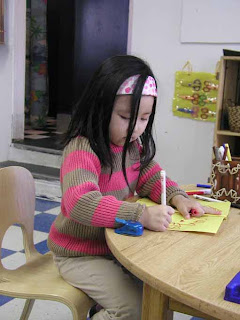
Now that we've become so comfortable with the alphabet, the children are really enjoying writing their own stories, or trying to spell out words on their own. This is something they are genuinely excited about, and I cannot tell you how thrilling it is. Many parents have been telling me that the excitement has also been happening at home, so encourage it whenever possible! Here are some photos of your young writers in action:


And finally, I'm sure you heard, but our field trip to the Natural History Museum (or, as some of the children referred to it as, the 'Matchural Mystery Museum') was a lot of fun. Most of us were able to explore the dinosaur halls in addition to the three floors of space exhibits. It's not just for kids, there is some real mind-blowing stuff at that museum, especially the 'Scales of the Universe,' which attempts to convey how small and insignificant we really are.
On that note!
Radha came to class on Friday to teach us about India. This was a wonderfully interactive experience, and each child was able to dress up in traditional Indian clothing while listening to Indian music. Bindis were available for anyone (boys, too) who wished to wear one.


The children love learning about new places and cultures. Feel free to come in and talk to the class about your family's heritage, and let me know if you need some ideas about what to do. Stories, cooking, pictures, and clothing are all great ways to show what it's like to live in another part of the world.
We had another special guest this week, when Amy came in to read the Icious Chronicles: Purplicious and Pinkalicious. These stories raised some great topics, including a discussion about debunking the idea of 'girl colors' and 'boy colors.' I was thrilled that many of the children were aware that anyone can choose to like any color.
 The children have been busy making many space drawings, including some wonderful astronauts. They are on display above the block area.


Valentine's Day is coming up, and we will be having a celebration of love. During the week, the children will be able to decorate their mailboxes (please bring in a shoe or tissue box) and can distribute valentines to their friends.
Also, I hope to take the class to the Museum of Natural History during the week of the 25th. The museum has some fantastic exhibits about the universe, and I know that everyone will enjoy the experience. I will keep you posted on a specific date.
And finally, what fruit is more appropriate to enjoy during an outer space unit than.... starfruit? Also called a carambola, this tart, slightly sweet, slightly sour, juicy and crunchy fruit was enjoyed by nearly every child in the room, including the converted naysayers who declare that they don't like it before even trying it. Success!

Let me just begin by saying... it thrills me how everyone has been absorbing all this information about outer space, like a sponge in the sea. I've heard several comments from parents about how much their child is talking about the universe at home, even citing facts regarding how it can be day in one part of the world and night in another, or simply mind-blowing ideas like, "Did you know that the Earth is moving RIGHT NOW? but we can't feel it??" (This is for the same reason why in an airplane, we do not feel like we are moving as fast as we actually are).One of the most valuable classroom resources for learning about outer space has been books. We have some terrific books that are filled with beautiful pictures and lots of information, and the children have been spending a great deal of time looking through them. What could be better?


 Everyone also thinks it's SO COOL that the inflatable Earth is now hanging from the ceiling, so we've begun a project to hang other heavenly bodies around the classroom. Last week, we began work on creating the sun. After looking at several pictures of the sun (and noting that it is super dangerous to look directly at it), we were able to decide on the colors of the materials to use for our own. The children used paint as well as a variety of collage materials to make two, and we will put them together with stuffing in the middle (newspaper probably) and then hang it up. We can repeat this with planets, at the children's discretion. I'm pretty sure they will want to make Jupiter and Saturn, two of their favorites.
 Some Sun facts we have discussed:
The Sun is a star, and stars are balls of really hot gas. Some stars are really big, some are really small; the Sun is average-sized. The hottest stars are blue, the 'coolest' are red, and yellow stars are in between. How hot a star is also determines its size (hotter = bigger). Everything in our solar system goes in circles (orbits) around the sun. Earth is the perfect distance ('just right,' like Goldilocks) from the Sun to allow life to survive. The Sun gives us light and heat. Nearly everything on the planet needs sunlight to live. When a star 'dies,' or can no longer give off heat and light, it explodes.
Sometimes this forms a black hole, but we haven't talked about that yet because, frankly, it's incredibly difficult to even comprehend that such a 'thing' exists out there. AAAH!!!
Many of the children enjoyed making moons out of our modeling clay. This happened after one child made a moon, complete with craters, without guidance from a teacher. The clay was out during freeplay, and the children could make whatever they desired, and it's just the bee's knees that this happened so purely. A similar thing happened when one child brought in a homemade telescope, fashioned from paper towel tubes. Emergent curriculum in action! These two activities were created by the children, literally. It gives me that warm fuzzy feeling inside.


The children's clay/space creations are on display above the writing center. Check them out!
We conducted a sometimes-successful experiment involving balloons, string, and straws, demonstrating how jet propulsion helps space shuttles (and airplanes) move so quickly. Below is a video illustrating one of the better trials.
And of course, the space ship has been getting a significant amount of use. Maintenance is required (duct tape = crucial), but this has been great training for the children who are future astronauts. When these children are grown up, I wonder what sorts of new knowledge we will have about space, because there is still so much we do not know. There are usually articles in the Science sections about new space discoveries, and there is almost always a high-tech satellite sending back photos of a planet or a moon, and this is where the internet rules, because you can see these photos as they come back. The internet is full of beautifully-detailed, high-resolution pictures from space that are worth checking out with your children.
I read one article this week about NASA's plans to beam The Beatles' "Across the Universe" directly into outer space. This is the first song to have this honor, and will celebrate 50 years of NASA and the 40th anniversary of the song's recording. It is being aimed at Polaris, the north star, some 430 light years away. For the record, that's 2,527,808,910,468,951 miles (4,068,114,103,209,744 kM) away. Uhh... what comes after trillions??
Is this government money well spent? Probably not. On a related note, about a decade ago, NASA sent some ladybugs into space to study how they behave in zero-gravity, and named four of them John, Paul, George, and Ringo.
But not all news stories about space involve The Beatles. Currently, the Mercury Messenger is taking photos of the planet Mercury, including sides of the planet previously unseen. The photographs are brilliant. Also, this Thursday, the space shuttle Atlantis will head up to the International Space Station to deliver supplies.
Go to http://news.bbc.co.uk in the Science/Nature section for some wonderful space articles, or also check out the NASA website.
That's all for now. Long post. Enjoy!
Our space technicians have been a truly dedicated crew, making sure our space shuttle is fully prepared for its inaugural launch next week. Work on the shuttle has been a genuine team effort, and everyone has been able to contribute in some way. Paint, glue, construction paper, crayons, markers, toilet paper tubes, plastic containers, three kinds of adhesive tape; all are essential to the performance of the children's work. Below are several photos, as well as a movie, showing how involved the children are with this project. It's wonderful!


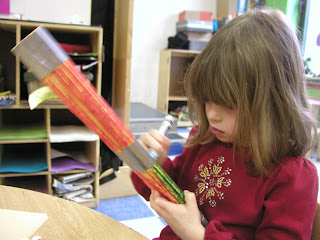
On Friday, the children excitedly assembled telescopes, a useful tool to gaze at the infinite heavens above. It can be hard to see much in the night sky in this city, but the moon is usually visible. Next time you're out with your child, take a look up and see what's there. I won't ever forget looking through a telescope when I was younger, in Florida, and actually seeing Saturn and its rings, would you believe it? It was truly a humbling and perspective-changing experience.


On display in the classroom are beautiful outer space scratch art drawings made by the children. They include imaginative descriptions involving many different planets, space ships, stars, aliens, and even the mysterious 'Planet X.'


Jessie, our new music teacher, sang a wonderful song with us about stars (video posted below). Her classes are very interactive, and every child is given multiple chances to offer their own approach to an activity.
 Thanks to everyone who participated in the pot luck dinner. It was a lot of fun, and there was so much delicious food! Remember, the school auction is approaching (February 11), so be sure to come out and support Columbus Preschool.


